

Written by Eric. Enjoy!
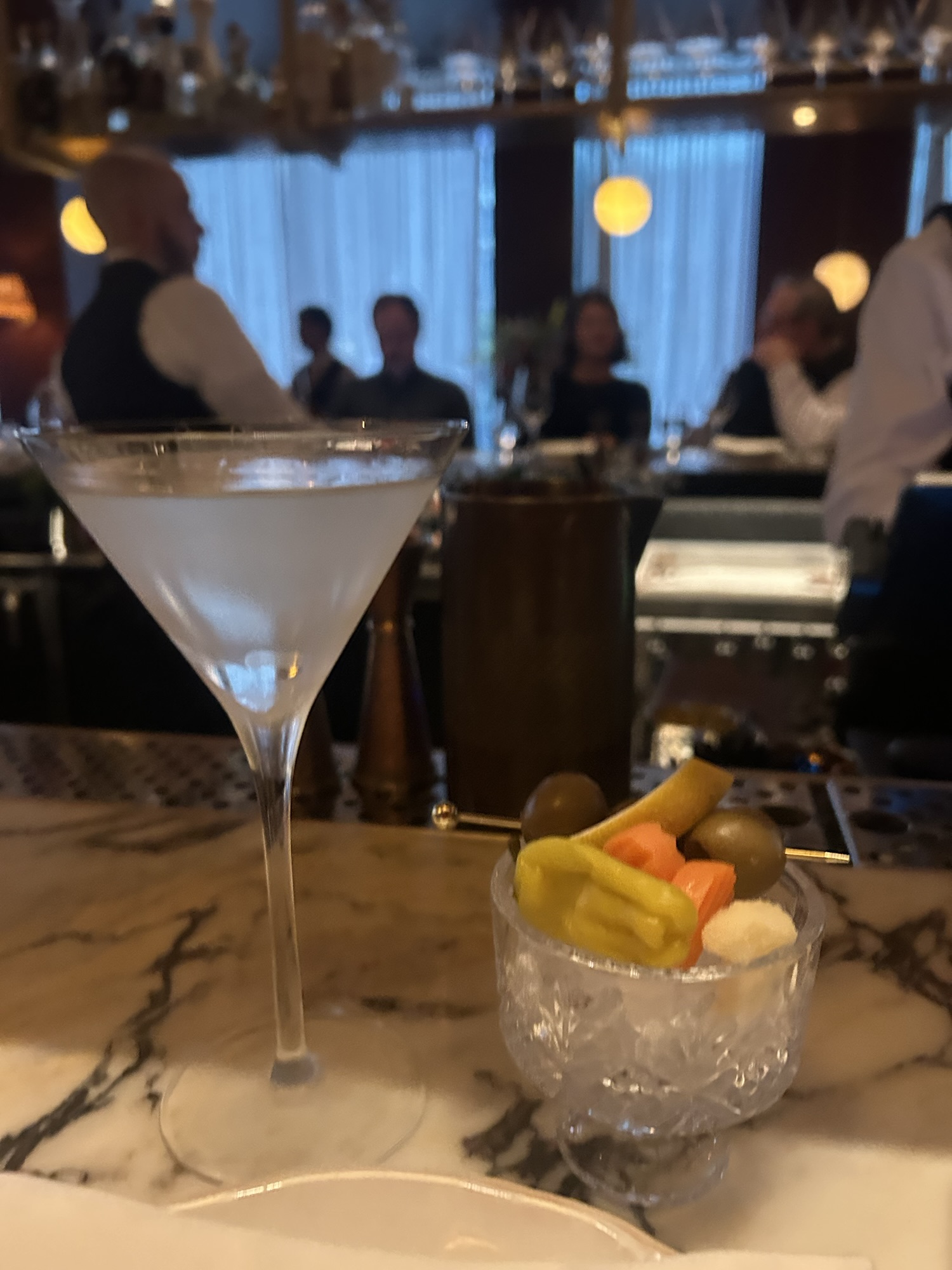
It’s Christmas time again: good cheer, holiday fare, eggnog (gross), travel (grosser), and relatives you only see once a year (grossest). Let’s forget the whole affair, put on your velvet smoking jacket (or Snuggie, you do you) and watch the greatest Christmas movie of all time – White Christmas. Oh, and grab your cocktail stirrer and put some glasses in the freezer, because we’re going to do this watch party Very Cold, Very Dry style.
I won’t bore you with historical tidbits or practical knowledge about White Christmas. That’s what The Wiki-Pedia (and to a lesser extent IMDB) is for (why does IMDB try to be a social media platform? Like, they want you to hang out, but you have to talk about film. No thank you.) In fact, if you’re not familiar with the plot, the shenanigans to follow here will probably not help you.
But since you twisted my arm, here’s what basically happens: Bing Crosby and Danny Kaye are big-shot Broadway luminaries Bob Wallace and Phil Davis. Rosemary Clooney and Vera-Ellen are their respective love interests, Betty and Judy Haynes. They’re trying to hit it big in the music business. Hijinks, transgenderism, folksy racism, and trauma-bonding ensue as they come together to save a cozy Vermont inn and its curmudgeonly owner.
(If this sounds like the plot of most Hallmark Christmas movies, you’re not wrong. White Christmas is a kind of ur-text, the font, if you will, of every Lacey Chabert-flavored cutesy misunderstanding beneath the mistletoe.)
(Also, this is a musical, with songs by Irving Berlin, a man who did not celebrate Christmas but has done more to shape how we celebrate it than anyone not named The Barefoot Contessa)

Oof, that was a lot of exposition. Let’s start the movie and get the first drink going.
Eric’s Classic Gibson
- 93ml, Bombay Sapphire London Dry Gin
- 7ml, Noilly Prat Extra Dry Vermouth
- 3 dashes, Fee Brothers Orange Bitters
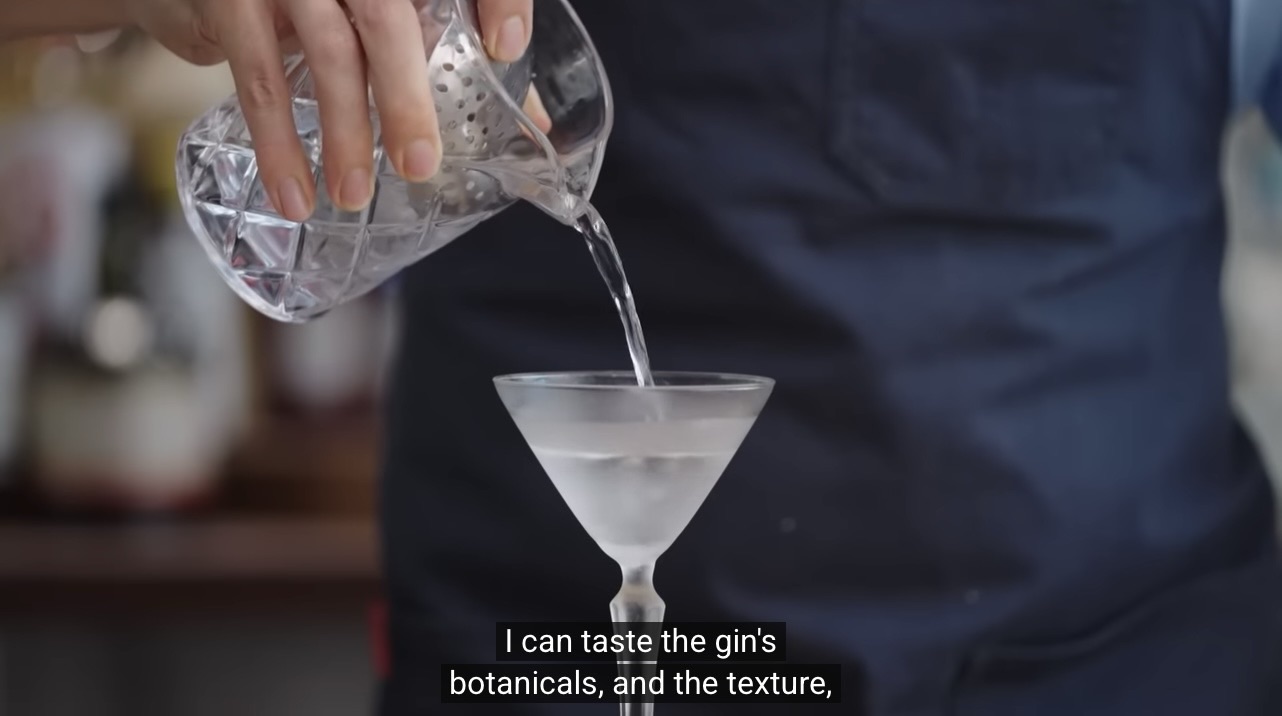
Using a kitchen scale, measure out the liquid ingredients as prescribed in a cocktail stirrer. Fill the stirrer with cubed ice and stir gently over ice until the molecules lie sensuously atop one another (or, until the outside of the stirrer is ice cold and frosty). Strain into a chilled cocktail glass. Garnish with 3 cocktail onions.
Act 1: If Bing Crosby Can Wear a Dress, Why Can’t We Accept Trans People?
Germany (or Italy, the movie doesn’t really specify). 1944. The Western Front. A hardscrabble band of American soldiers shelter beneath the crumbling ruins of a town they recently blasted to rubble in the name of Democracy. No enemy soldiers or civilians are found in this scene. Instead, our boys take in a Christmas musical act. Bob Wallace (Crosby) and Phil Davis (Kaye) hee-haw about the stage before a mood whiplash has Crosby singing “White Christmas,” to the homesick chagrin of our boys at the front.
General T.J. Waverley (Dean Jagger, and the character with whom I identify the most) arrives, stumbles his way through a farewell speech (he’s retiring before he can be indicted for war crimes for OBLITERATING this peaceful European village, ostensibly), before Wallace and Davis sing him off stage with “We’ll Follow the Old Man.” (Fun Fact 1: Berlin wrote the songs for White Christmas, but not necessarily for this movie. Most of them are rehashed from previous films, which makes Berlin brilliant for getting paid twice for the same work).
The (German? Italian? Is this a friendly fire scenario?) Air Force promptly strafes the show. Davis saves Wallace from being killed by a styrofoam brick wall that threatens to crush his career. Wallace now owes Davis a life debt. Now, after the war he has to partner with Davis and endure his absurd brand of living permanently. Indeed, they spend most of the film bickering like The Lockhorns or Fred & Ethel Mertz.
(If you’re not here for shamelessly lame cultural references, I’d quit now if I were you.)
Wallace and Davis become famous. They’re on the radio, the stage, the television, and finally they’re in Miami checking out The Haynes Sisters show (Clooney as Betty, and Ellen as Judy) because their “old pal in the Army” is their brother, and they’d do anything for him. This is Band of Brothers-level serious. (Fun fact 2: the photograph of Benny Haynes that Clooney will show Wallace and Davis is the actor who played Alfalfa in Our Gang [or, The Little Rascals if you’re of a certain age])
Betty and Judy sing “Sisters,” a song about one attractive sister and the other, unattractive one who will eventually murder her and appear on a Dateline special. The Sheriff (of Miami?) arrives to arrest the sisters for burning a hole in their rented room carpet. Since this is Florida, this is undoubtedly a capital offense. Wallace and Davis sneak the girls out a window and then perform Sisters…in drag.

Now let’s take a beat. It is 1954. This drag scene is so much fun, you can hear RuPaul getting all swishy. Bing Crosby is in a periwinkle tiara, feather fan, and a dress prancing around for all Miami to see. If we can accept the ol’ Bingle in a ball gown, then I think we can go the extra mile in our daily lives.
Wallace and Davis escape the Sheriff (and more importantly, Florida), just managing to hop a train to New York City. They’re headed to the Big Apple to promote their new musical (Hangin’ Around, which, as you will see, is a variety act with no real plot) on The Ed Harrison Show (a not-so-coy expy of Ed Sullivan). But they meet the girls again, and they’re off to Vermont instead, with dreams of snow and a winter wonderland (brilliantly exposited in the quartet number “Snow.”)

(The “Snow” scene is notable for being one of the few moments a person of color appears in the movie: the club car attendant who serves the quartet their meal)
Why the change of plans? Davis can’t stand that Wallace is a “cold, lonely, miserable man.” A girl will soften him up! That way, Davis can get 45 minutes all to himself for a massage, apparently (not going anywhere NEAR this one). Wallace tries, but Davis reminds him that if not for his heroism, Wallace would have come home from the war being carried by the handles by six of his closest friends. Vermont, here we come!
Act 2: An Inconvenient Holiday Truth, or Bing Crosby Takes On Climate Change
Whew! Exhausted by all this holiday cheer yet? I know I am. Time for a martini!
The Dry Lime
- 3oz., Citadelle “Jardin d’Ete” Dry Gin
- 0.25oz., Tenuta di Aglaea Dry Vermouth
- 3 dashes, Fee Brothers Lime Bitters
- Lime twist, to garnish
Using a kitchen scale, measure out the liquid ingredients as prescribed in a cocktail stirrer. Fill the stirrer with cubed ice and stir gently over ice until the molecules lie sensuously atop one another (or, until the outside of the stirrer is ice cold and frosty). Strain into a chilled cocktail glass. Garnish with the lime twist.
If this martini feels a little too “summer” for late December, you’re not wrong. We might be headed to Vermont but the weather is far from winter. Our quartet is stunned to learn that it’s nearly 70 degrees and no snow is forecast for the little hamlet of Pinetree. In 1954, this was one of life’s greatest tragedies. In 2025, this is called “what happens in New England every year.”
To make matters worse? The inn that Betty and Judy were scheduled to sing at all season tries to cancel on them. But, our old friend and war criminal General Tom Waverley turns up. He’s the owner of this slice of Vermont, and refuses to turn the girls, or Wallace and Davis, out at Christmas. (Hallmark viewers will be familiar with this trope: the world is a closed system, and the grandest coincidences are handwaved away easily).
General Waverley refuses any attempt by Betty, Judy, Phil, or Bob (clearly, he is on the run from The Hague). So, naturally, they all decide to help him anyway. Wallace and Davis bring their whole cast, crew, and sets up to Vermont to perform, believing the slack-jawed hicks of upstate Vermont will simply fall over themselves to see a real Broadway musical. We’re now treated to a few of their numbers, including “Mandy.”
Let’s talk about Mandy. On the face of it, “Mandy” is a song about the eponymous girl being courted by a variety of suitors. The choreography is incredible, to be sure. But “Mandy” is actually a minstrel number. As in, performances of it would be done in blackface by white performers. White Christmas actually refuses to do this (despite there being red-painted faces on the set backgrounds mimicking blackface, if you look closely). An earlier Crosby holiday movie, Holiday Inn, did in fact feature The Bingle in blackface. Yikes.

(This is also the point in the movie where you may be asking yourself, “does Vera Ellen (Judy) have an eating disorder? The answer? Probably. Then, as now, there was tremendous pressure on women to look a certain way, especially in entertainment. Then again, first-hand accounts from friends and family furiously deny anything of the sort.)
(Fun Fact #3: Vera Ellen’s Judy is the younger sister to Rosemary Clooney’s Betty. Vera Ellen was 7 years older than Clooney in real life.)
Wallace and Davis’s efforts only go so far. General Waverley tries to rejoin the Army, but the Pentagon admonishes him to stay put in Vermont, not wishing to re-deploy the Butcher of Bielefeld. Wallace and Davis hatch a plan to help the General one more time, by giving him “the greatest Christmas present” he’ll ever get – a reunion of the old Army brigade on Christmas Eve. Their secret plan includes Wallace going on the Ed Harrison Show and asking the unit to come up to Vermont to surprise the old man.
Seems simple enough, right? Wrong. Betty, who is falling madly in love with Bob, gets some wrong information about this plan. She thinks that Bob is taking advantage of the General to drum up national attention for Hangin’ Around. Furious, she decides to give Bob the silent treatment before running away to New York City after Phil and Judy’s plan to use a fake marriage proposal (best not to ask questions here) to get them back together backfires.
Here we encounter another familiar Hallmark-y trope: the complete and utter lack of simple communication skills among grown adults. Had Betty asked Bob about this plan (hell, if she had confronted him in a frothing rage about it), Wallace could have easily explained the whole plan. But, this being 1954 and all, Betty clearly lacks the emotional maturity to engage in conversation with another human being.
So, Betty’s gone; Bob’s still a lonely, miserable man; Judy is blithely unaware of her role in perpetuating racial stereotypes; and Phil is comparing women to cocker spaniels left and right. This is healthy.
Act 3: This Is Not How The National Rail System Works
We’re almost there! Remember the words of Joe E. Lewis: You’re not drunk if you can lie on the floor without hanging on.
The Hot n’ Dirty
- 3oz., Tanqueray No. 10 Gin
- 0.25oz., Dolin Dry Vermouth
- 0.25oz., or more to your taste, olive brine
- 0.25oz., or more to your taste, hot vinegar pepper brine
- 3 blue cheese olives, to garnish
Using a kitchen scale, measure out the liquid ingredients as prescribed in a cocktail stirrer. Fill the stirrer with cubed ice and stir gently over ice until the molecules lie sensuously atop one another (or, until the outside of the stirrer is ice cold and frosty). Strain into a chilled cocktail glass. Garnish with the olives.
It’s hot and dirty time! We need something spicy because Rosemary Clooney is about to light this whole thing on FIRE. “Love, You Didn’t Do Right By Me” is an underrated torch song about a scorned lover after a vicious breakup. But who cares about the song when, yowza, just look at Rosemary Clooney in that dress! If I was Bing Crosby I’d be hanging onto my rosary beads a little tighter after this scene.

Wallace goes to New York City to make his plea to the brigade to come to Vermont. He takes in Betty’s performance at the Carousel Club, imploring her for a date. She ices him out completely, still refusing to explain why. Meanwhile, back in Vermont, Phil Davis fakes a “small, internal muscular hemmoraghe” in his leg to get General Waverley away from the television so the whole plot isn’t ruined. Davis gets The General to help him walk slowly around the inn in a way that would make Eartha Kitt’s Catwoman blush with envy.
Betty’s also watching the performance on television. Wallace tells the audience (and her) that this is a purely selfless act to honor General Waverley. Betty throws away (again?!) her career opportunity and heads back to Vermont, hopefully in time for the Big Finale.
What’s Bob Wallace’s plan to get the brigade to this one-dirt-road town in Vermont? Having the Pinetree station-master schedule a whole bunch of “special trains” (literally the line in the movie) on Christmas Eve. Can you imagine trying this nonsense in today’s world? “Oh, hello, Amtrak. I am a famous person, and I would like you to schedule like nine more trains on the busiest travel day of the year from Grand Central in New York to Yokelstown, Vermont.”
Meanwhile, back in Vermont, General Waverley is blissfully unaware that a THOUSAND PEOPLE are descending on his inn. How, you might ask, is this cunning warrior distracted? The housekeeper has sent both (BOTH!) of his suits to the dry cleaners. He threatens to court-martial the housekeeper, which is more than a little ironic coming from the Destroyer of Düsseldorf. Waverley’s granddaughter, Susan, convinces him to come to the Big Finale in his uniform, which he begrudgingly does.
(I’ve elided over a lot in this essay, but yes, Susan Waverley has been with us the entire time. Why is she at the inn for Christmas with her grandfather? It’s never addressed. A jolly school vacation? Sure. Dead parents? Why not. Secretly gathering information for the International War Crimes Tribunal? Who’s to say. She’s utterly incidental to the plot of the whole movies except to get General Waverley into his uniform).

Now, here’s where I give in to sentiment over sarcasm. General Waverley enters the dining room/theater to a standing ovation, a cake, and, of course, a reprise of “We’ll Follow the Old Man” from his troops. It is a heartwarming moment, one which reminds us that while we may go on alone, sure that the only person we can trust is ourselves, we have made a positive impact on more lives than we could truly know.
All right, that’s enough of that. Betty comes back, surprising Bob completely. She never quite explains why she got upset in the first place, but, hey, who cares when you’re in love! Phil and Judy also decide to shack up, again because why not? It snows (proving once and for all climate change is not real, and Christmas magic will save us all from tHe LiBeRaLs) and the whole cast sings “White Christmas” one last time. Everyone lives happily ever after, except probably the railroad station master who now has to testify before a Congressional committee about why he threw the entire Northeast railroad network into utter chaos on Christmas Eve to satisfy one man’s savior complex.
If you’ve seen White Christmas one time or a hundred times, I hope that this write up gave you a chuckle. If you’ve never seen it, I hope you’ll take the hour and fifty minutes to give it a watch. It’s certainly a lovely film worthy of praise as much as a gentle bit of fun poked its way.
And so, this holiday season, remember the immortal pick-up line of Phil Davis, “You know, in some ways, you’re far superior to my cocker spaniel.”




Leave a Reply